BNP Paribas 2026 Global AI Conference
夏志敏参加BNP2026全球人工智能大会 - 具身智能深度解析
🌟 Conference Significance | 会议重要性
🏦 Global Financial Institution Host | 全球顶级金融机构主办
法国巴黎银行(BNP Paribas)是欧洲最大、全球领先的金融服务集团之一,其主办的全球AI大会汇聚了来自世界各地的AI领域顶尖专家、投资人和产业领袖。本次会议聚焦具身智能(Embodied Intelligence)这一AI最前沿方向,标志着传统金融机构对AI物理世界落地的高度关注。
BNP Paribas, one of Europe's largest and globally leading financial services groups, hosted this Global AI Conference bringing together top AI experts, investors, and industry leaders worldwide. The focus on Embodied Intelligence signals traditional finance's high attention to AI's physical world deployment.
🤖 Cutting-Edge Topic | 前沿议题
具身智能被誉为"人工智能的终极形态",是连接数字智能与物理世界的关键桥梁。本次演讲深入探讨了从GPT-2阶段到大规模商业落地的完整路径,涵盖了数据瓶颈、仿真训练、VLA模型演进、开源生态、硬件成本优化等13个核心议题,为行业提供了系统性的认知框架。
Embodied Intelligence is regarded as the "ultimate form of AI," the critical bridge connecting digital intelligence with the physical world. This speech explored the complete path from GPT-2 stage to large-scale commercial deployment, covering 13 core topics including data bottlenecks, simulation training, VLA evolution, open-source ecology, and hardware optimization.
🌏 China-US-Europe-Japan-Korea Landscape | 全球竞争格局
演讲首次系统性地对比了中国、美国、日本、韩国在具身智能领域的竞争优势,指出中国凭借全链路工业场景整合、完整低成本供应链和快速商业验证能力,正在形成全球最 robust 的产业落地体系。这一观点为理解全球AI产业格局提供了重要参考。
The speech systematically compared competitive advantages of China, US, Japan, and South Korea in embodied intelligence, highlighting China's unique strengths in full-link industrial scenario integration, complete low-cost supply chains, and fast commercial verification capabilities, forming the world's most robust industrial landing system.
💡 Industry-First Insights | 行业首创观点
演讲提出了多个行业首创性观点:"80%仿真训练+20%真实数据校准"的工业标准配方、数据成本100倍下降与有效数据量1000倍扩张的"双百定律"、以及"开源为主体、闭源为补充"的行业格局预判。这些量化指标和结构性判断为产业投资和技术路线选择提供了明确指引。
Industry-first insights included: the "80% simulation + 20% real data calibration" industrial standard formula, the "Dual-Hundred Law" of 100x data cost reduction and 1000x valid data expansion, and the "open source as main body, closed source as supplement" industry pattern prediction. These quantitative metrics provide clear guidance for investment and technology roadmap decisions.
👤 Speaker Profile | 演讲者简介
夏志敏博士 | Daniel Xia, Ph.D.
夏志敏博士 现任 Boston Institute of Artificial Intelligence Vice President,是具身智能(Embodied Intelligence)领域的资深专家。他在AI产业化、机器人技术、智能制造等方面拥有丰富的研究与实践经验。本次在 BNP Paribas 2026 Global AI Conference 上的演讲,系统性地阐述了具身智能从GPT-2阶段到大规模商业落地的完整路径,提出了"双百定律"、"80-20配方"等行业首创性观点,为产业投资和技术路线选择提供了明确指引。
Dr. Daniel Xia (夏志敏) is Vice President of Boston Institute of Artificial Intelligence and a senior expert in Embodied Intelligence. He has extensive research and practical experience in AI industrialization, robotics technology, and intelligent manufacturing. His speech at BNP Paribas 2026 Global AI Conference systematically outlined the complete path from GPT-2 stage to large-scale commercial deployment, proposing industry-first insights like the "Dual-Hundred Law" and "80-20 Formula".
📸 Event Photos | 现场照片
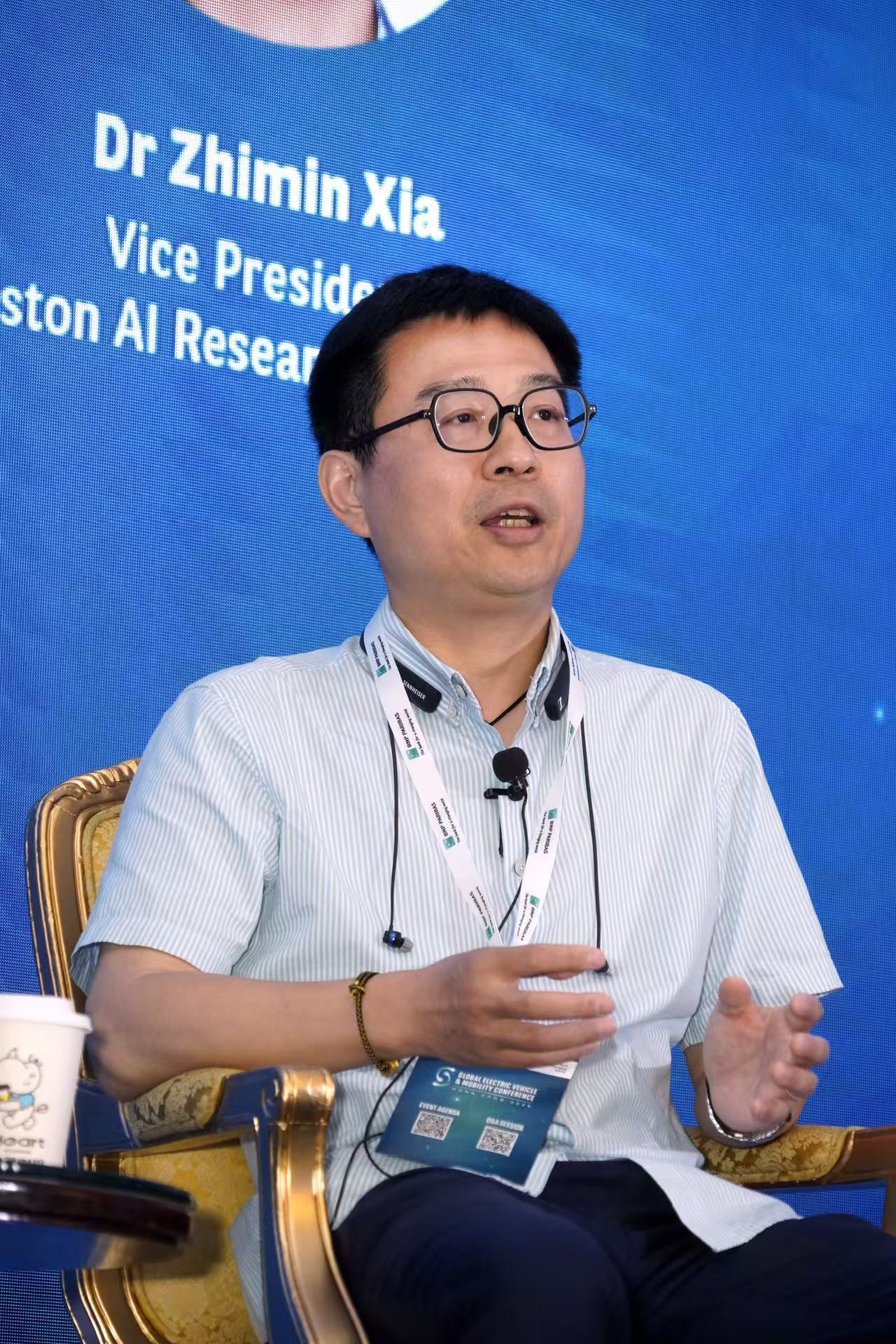
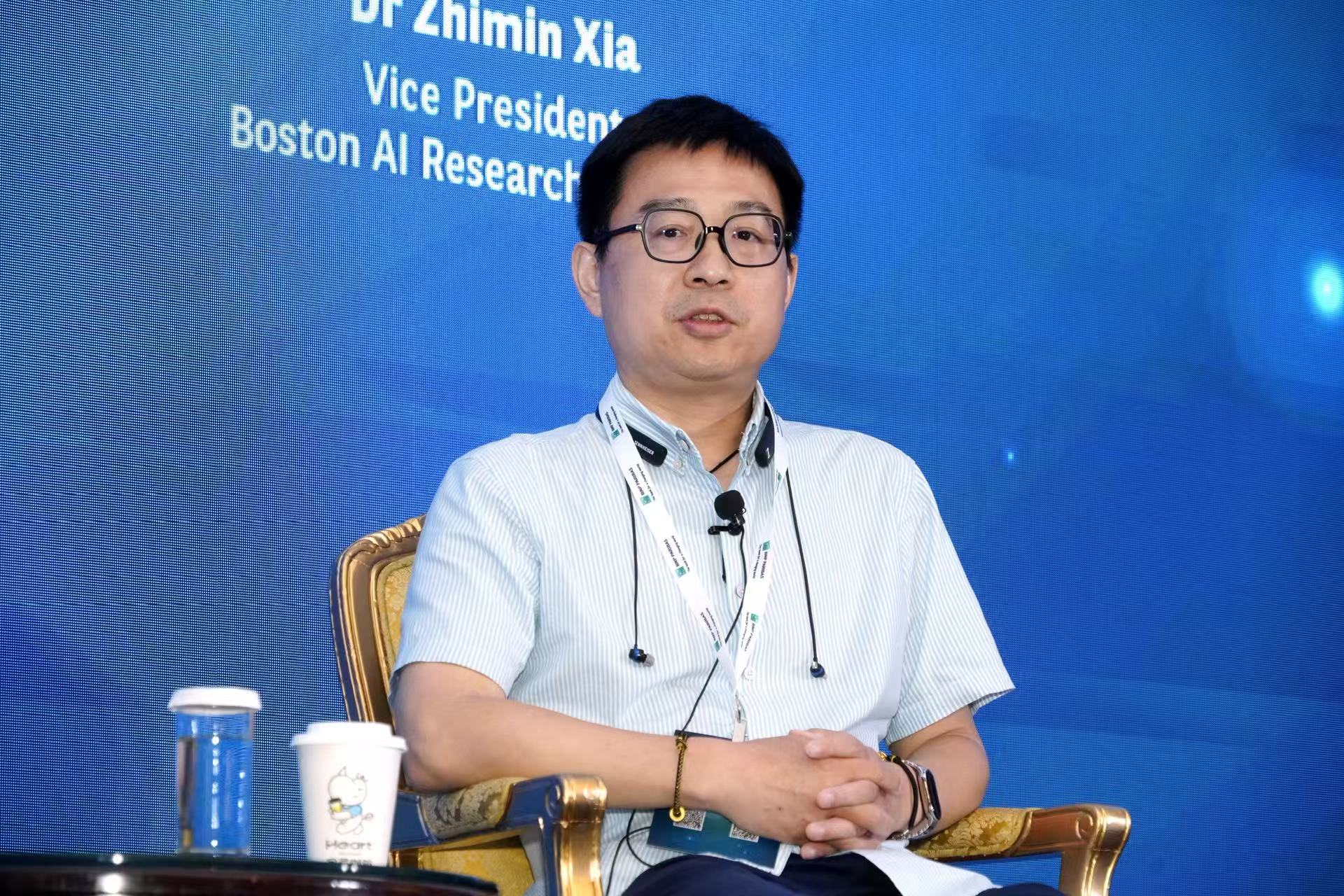
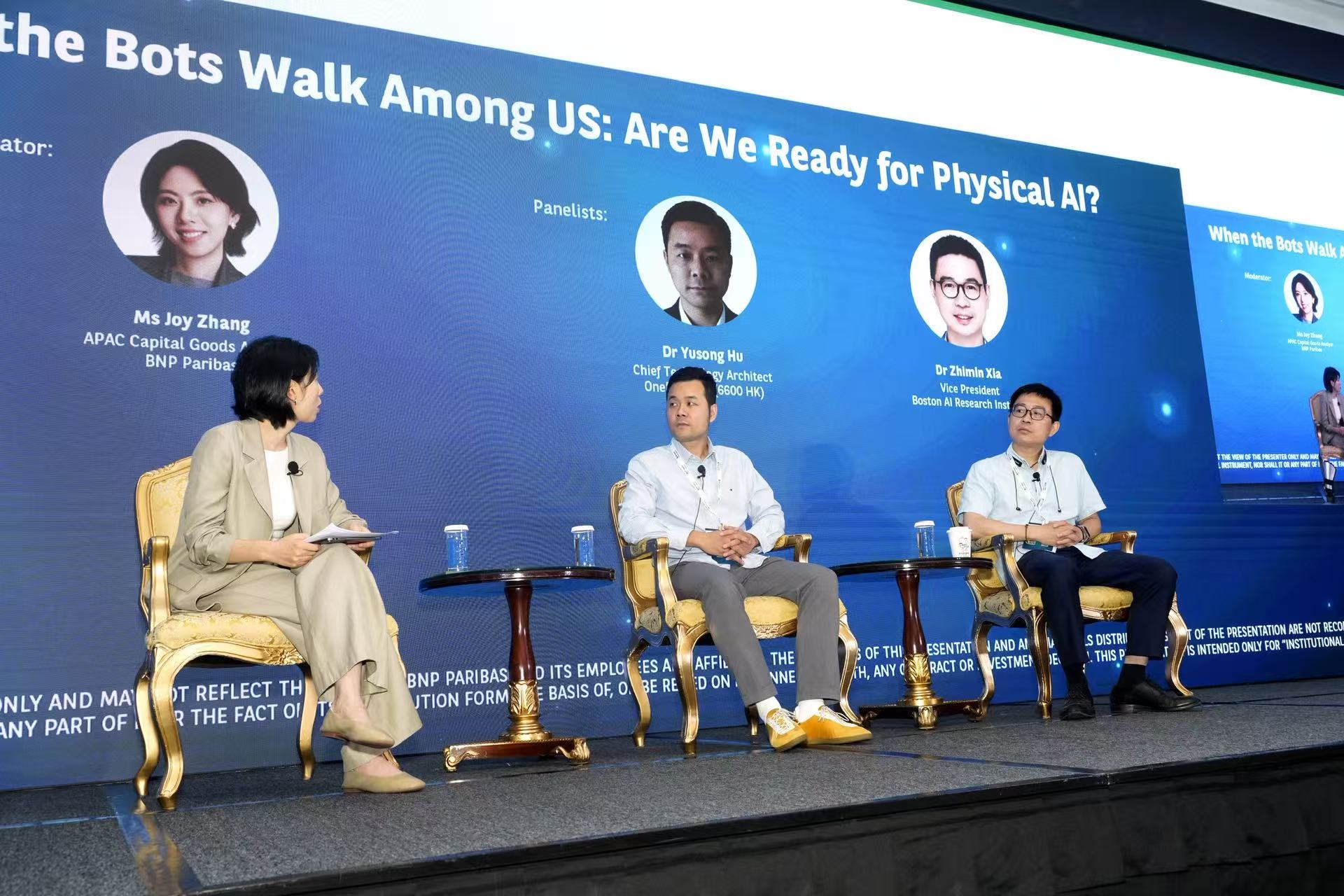
🔗 Related Links | 相关链接
Event Microsite | 会议微网站
Full event details and speaker information | 完整会议详情和演讲者信息
https://s1.nsloop.com:8317/lx/hk519.html →💡 Key Unique Insights | 主要独特观点
📊 "Dual-Hundred Law" | "双百定律"
未来三年,通过仿真生成、人类视频学习、自监督探索和行业数据联盟四大路径,数据成本将下降100倍,有效数据量将扩张1000倍。
In the next three years, through simulation generation, human video learning, self-supervised exploration, and industry data alliances, data costs will drop 100x and valid data volume will expand 1000x.
⚖️ "80-20 Formula" | "80-20配方"
工业级具身智能的标准训练配方:80%仿真训练 + 20%真实数据校准 + 持续仿真到真实对齐。
Industrial embodied intelligence standard training formula: 80% simulation training + 20% real data calibration + continuous sim-to-real alignment.
🔄 Industry Stage Positioning | 产业阶段定位
当前具身智能处于"垂直突破早期",对标大语言模型的GPT-2阶段。通用具身智能仍需3-5年成型,大规模实用化需10年。
Current embodied intelligence is in the "early vertical breakthrough" stage, equivalent to GPT-2 era of LLMs. General embodied intelligence needs 3-5 years to take shape, and 10 years for large-scale practical deployment.
🌐 Open Source Dominance | 开源主导格局
开源生态正在重塑甚至颠覆行业规则,未来格局将从"闭源垄断"转向"开源为主体、闭源为补充"的新范式。
Open source ecology is reshaping and even subverting industry rules. The future pattern will shift from "closed-source monopoly" to "open source as main body, closed source as supplement."
🏭 China's Unique Advantage | 中国独特优势
中国凭借海量工业场景全链路整合、完整低成本供应链和快速商业验证能力,正在形成全球最 robust 的产业落地体系。
China, with massive industrial scenario full-link integration, complete low-cost supply chains, and fast commercial verification capabilities, is forming the world's most robust industrial landing system.
🧠 VLA + World Model Integration | VLA与世界模型融合
未来方向是VLA与世界模型的深度融合,形成三层分层架构:底层实时反射响应、中层技能组合、高层长期任务规划。
The future direction is deep integration of VLA and world models, evolving into a three-layer hierarchical architecture: low-level real-time reflex response, middle-level skill combination, and high-level long-term task planning.
具身智能当前产业阶段和核心挑战是什么?
Key Insights | 核心观点 (5 min)
English: We are still in the early vertical breakthrough stage, roughly equivalent to the GPT-2 era of LLMs. The industry went through concept verification from 2022 to 2024, and is now in vertical scenario iteration. General embodied intelligence is still 3-5 years away from taking shape, and 10 years from large-scale practical deployment.
中文:我们仍处于垂直突破早期,对标大语言模型的GPT-2阶段。2022-2024年为概念验证期,2024-2026年为垂直场景迭代期。通用具身智能成型需3-5年,大规模实用化需10年。
The industry faces three fundamental bottlenecks: extreme scarcity of real robot interaction data, a persistent sim-to-real gap, and strict real-time response requirements that do not exist in traditional large models. | 行业面临三大根本瓶颈:真实机器人交互数据极度稀缺、仿真到真实迁移鸿沟无法弥合、以及传统大模型不具备的毫秒级实时响应硬约束。
如何评价当前数据获取效率和未来提升空间?
Key Insights | 核心观点 (2 min)
English: Data is the oil of embodied intelligence, but current real-data collection is costly and inefficient, costing several dollars per high-quality data point.
中文:数据是具身智能的石油,但目前真实场景数据采集成本高昂、效率低下,每条高质量数据成本高达数美元。
In the next three years, four solutions - simulation generation, human video learning, self-supervised exploration, and industry data alliances - will drive a 100x cost reduction and a 1000x expansion of valid data volume. | 未来三年,仿真生成、人类视频模仿、自监督探索、行业数据联盟四维并进,将驱动数据成本下降100倍、有效数据量扩张1000倍。
仿真训练能否替代真实数据?
Key Insights | 核心观点 (2 min)
English: Simulation cannot fully replace real data, but it can drastically reduce reliance on it. Simulation has advantages in cost, speed, safety and repeatability. However, it cannot perfectly restore real-world physical details, environmental noise, and complex contact mechanics.
中文:仿真无法完全替代真实数据,但可以大幅降低对真实数据的依赖。仿真在成本、速度、安全性、可重复性上有优势,但无法完美还原真实世界的物理细节、环境噪声和复杂接触力学。
The industrial standard is: 80% simulation training + 20% real data calibration + continuous sim-to-real alignment after each deployment. | 工业通行方式是:80%仿真训练 + 20%真实数据校准 + 每次部署后的持续仿真到真实对齐。
VLA和世界模型的未来演进路径是什么?
Key Insights | 核心观点 (2 min)
English: Current VLA models suffer from short planning horizons, weak causal reasoning, and insufficient long-term memory.
中文:当前VLA模型存在三大短板:规划 horizon 太短、只懂关联没有因果、缺乏长期记忆。
The future direction is the integration of VLA and world models, evolving into a three-layer hierarchical architecture: low-level real-time reflex response, middle-level skill combination, and high-level long-term task planning. The core iteration goals are causal understanding and lifelong continuous learning. | 未来方向是VLA与世界模型的深度融合,形成三层分层架构:底层实时反射响应、中层技能组合、高层长期任务规划。核心迭代目标是因果理解和终身持续学习。
开源生态能否重塑具身智能行业规则?
Key Insights | 核心观点 (2 min)
English: Yes, open source is reshaping and even subverting the industry. Open-source models have crushing advantages in training and inference costs, while bringing complete data sovereignty and customizable rights to enterprises.
中文:是的,开源生态正在重塑甚至颠覆行业。开源模型在训练和推理成本上有碾压性优势,同时让企业拥有完整数据主权和定制权。
The industry will gradually shift from closed-source monopoly to a new pattern of "open source as the main body, closed source as supplement". | 行业将逐渐从闭源垄断转向"开源为主体、闭源为补充"的新格局。
当前具身机器人硬件的根本短板在哪里?
Key Insights | 核心观点 (2 min)
English: Hardware bottlenecks are concentrated in three dimensions: perception, motion actuation, and structural integration.
中文:硬件瓶颈集中在三个维度:感知、运动执行、结构集成。
Perception cannot balance precision, cost and energy consumption; dexterous operation conflicts with load capacity and battery life; lightweight design restricts structural strength and integrated computing power. These are the core physical barriers for industrial landing. | 感知无法平衡精度、成本和能耗;灵巧操作与负载、续航相互矛盾;结构轻量化限制强度和算力集成。这些是工业落地的核心物理壁垒。
硬件成本下降空间有多大?终极目标是?
Key Insights | 核心观点 (1.5 min)
English: Driven by scale production, supply chain spillover and component price decline, the overall hardware cost will continue to drop rapidly. Large-scale mass production will significantly cut GPU and motor costs, bringing robot hardware closer to industrial-grade affordable pricing in the next 3-5 years.
中文:受规模量产、供应链外溢、元器件降价驱动,整体硬件成本将持续快速下降。未来3-5年,大规模量产将显著削减GPU等高溢价部件成本,机器人硬件成本将逼近工业级可承受价格区间。
中国供应链成熟度和后发优势如何?
Key Insights | 核心观点 (1.5 min)
English: The global embodied hardware supply chain has reached 60%-70% maturity. Late entrants can fully reuse consumer electronics and new energy vehicle supply systems, saving 3-5 years of construction cycle and achieving lower cost and faster iteration speed.
中文:全球具身硬件供应链成熟度已达60%-70%。后入者可以完整复用消费电子和新能源车供应体系,节省3-5年建设周期,实现更低成本和更快迭代速度。
工厂场景商业化的最大痛点是什么?
Key Insights | 核心观点 (1.5 min)
English: Factory scenarios require high precision, long-term stability and low maintenance cost. The core pain point is the mismatch between standardized hardware and personalized factory environments, including environmental interference, low fault intervals, and long customization adaptation cycles.
中文:工厂场景要求高精密、长稳定、低维护。核心痛点是标准化硬件与个性化工厂环境的错配,包括环境干扰、设备故障间隔低、定制化适配周期长。
任务专用、一脑多形、通用全能,哪条技术路线更可靠?
Key Insights | 核心观点 (1.5 min)
English: At this stage, task-specific robots are the most reliable and commercializable route with verified stability and low maintenance costs. One-brain-multi-form has long-term scalability but is limited by algorithm maturity. Universal general robots are still in the long-term research stage.
中文:现阶段任务专用机器人是最可靠、最可商业化的路线,稳定性经过验证且维护成本低。一脑多形具备长期扩展性但受限于算法成熟度。通用全能机器人仍处于长期研究阶段。
传统工业机器人龙头与AI新进入者,谁的优势更强?
Key Insights | 核心观点 (1.5 min)
English: Traditional leaders have advantages in hardware reliability, supply chain and industrial certification. New AI entrants dominate in algorithm iteration, software flexibility and scenario generalization. The future competition is a combination: traditional manufacturers upgrade intelligence, while AI startups complete hardware industrialization.
中文:传统龙头胜在硬件可靠性、供应链和工业认证。AI新进入者胜在算法迭代、软件灵活性和场景泛化。未来是融合竞争:传统厂商升级智能化,AI团队补齐工业硬件化。
工业具身智能的安全与隐私红线如何定义?
Key Insights | 核心观点 (1 min)
English: Physical safety relies on hierarchical permission control, emergency braking and manual takeover mechanisms to ensure controllable robot operation. Privacy red lines require full desensitization of factory production data and interactive data to meet industrial compliance requirements.
中文:物理安全依靠分级权限、紧急制动和人工接管机制确保机器人可控运行。隐私红线要求工厂生产数据和交互数据全面脱敏,满足工业合规要求。
中国、美国、日本、韩国的竞争优势分别是什么?
Key Insights | 核心观点 (2 min)
English: The US defines core algorithms and technical frameworks. Japan and Germany focus on ultra-high hardware reliability. South Korea excels in rapid scenario replication and standardized mass production. China's unique advantage is the full-link integration of massive industrial scenarios, complete low-cost supply chains, and fast commercial verification capabilities.
中文:美国定义核心算法和技术框架。日本和德国聚焦超高硬件可靠性。韩国擅长快速场景复制和标准化量产。中国独特优势在于海量工业场景全链路整合、完整低成本供应链和快速商业验证能力。